
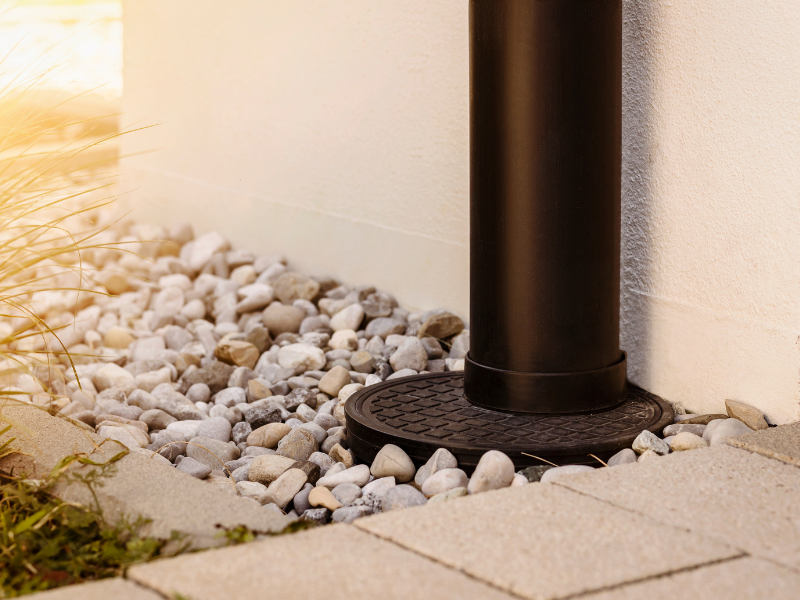
There is a kind of damp that creeps. It doesn’t burst in like a flood. It seeps. A slow climb up brickwork. A watermark that darkens and spreads with time. If you’ve seen it, you’ll know. And if you’ve dealt with it, you’ll want to stop it from ever coming back.
That’s where the French drain comes in.
A French drain isn’t French. And it’s not a drain in the way a kitchen sink has a drain. It’s older, simpler, and more effective than you’d expect. The idea is obvious, so much that you might miss it-until you see how much damage it prevents.
The Simple Bit
At its core, a French drain is a shallow trench. Inside it, there’s a pipe. Around the pipe, there’s gravel. The trench leads water away from where you don’t want it—usually the base of a house or wall—and sends it somewhere safer.
No moving parts. No machines. Just physics, slope, and gravity.
The pipe has small holes in it, allowing water to seep in. As rain hits the ground, it sinks through the gravel, enters the pipe, and drains away instead of pulling against the wall. Hence, no damp.
Where It Makes Sense
Not every house needs one. But you might if your garden turns boggy after a rainy day or your basement smells like wet plaster.
It’s most useful where the soil doesn’t drain well. Clay soil, for instance, can hold water like a sponge. If your home is built on a slope and sits at the lower end, surface water tends to run toward it. That pressure builds up, and unless it’s relieved, it pushes its way into bricks, mortar, and under floors.
That’s what a French drain relieves—pressure. It doesn’t just move the water. It lifts a weight you can’t see until it’s too late.
How It’s Put In
It starts with digging, usually a trench around the perimeter of a property or alongside a problem wall. It needs a slight gradient—around 1 in 100 is enough. That’s one centimetre of drop per metre of trench.
Once dug, the trench is lined with fabric to prevent soil from entering the gravel and blocking the pipe.
Then, the perforated pipe is laid. It runs at the base of the trench, wrapped in gravel. The trench is then filled in—sometimes with more gravel at the top or covered with turf or paving if it’s a garden path.
The result? No standing water. No soggy flower beds. And no rising damp.
French Drain vs Soakaway
There’s confusion here. People often mix them up.
A soakaway is a hole. You dig it deep, fill it with rubble or crates, and let water collect and slowly seep into the ground. It deals with water in one place.
A French drain is more like a guide. It leads the water away. It works over distance.
In some homes, you’ll see both. A French drain feeds into a soakaway. The first moves water; the second gets rid of it.
The Real Benefit
There are costs, of course. There’s digging, materials, labour. If it’s not done carefully, you can end up with a trench that looks like someone forgot to finish the job.
But done properly, it’s a sort of safety measure. It sits underground, unnoticed. Years pass, and you forget it’s there. That’s the point. The water runs away. The walls stay dry. You avoid rot, mildew, crumbling render, and all the subtle signs that your home is under attack from the earth itself.
FAQs
Is a French drain expensive to install?
It depends on the size of the area and the materials used. But it’s generally cheaper than repairing a damp wall or replacing floor joists.
How deep should it be?
Usually between 300mm and 600mm. Deep enough to catch the water near the surface, shallow enough not to interfere with foundations.
Can I build one myself?
If you’re handy with a spade and understand gradients, yes. But you’ll need to plan where the water will go. Dumping it onto your neighbour’s property is a fast way to fall out.
Do they work on flat ground?
They can, but they need a clear outlet. Without a slope, you may need a sump and pump.
Do French drains need maintenance?
Not much. But they can clog with silt over time. If the ground stops draining and puddles reappear, you may need to dig it out and clean the pipe.
Are you tired of soggy ground and creeping damp?
Book a free drainage assessment today and find out if a French drain could fix the problem before it gets worse.